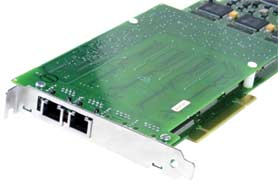
SmartWORKS™ DP

産品手册

點擊下面獲取最新産品手册

PDF文件下載
T1/E1 Passive TAP Card


Key Features and Benefits

Software Switchable T1/E1 Interface
Supports T1 and E1 using the same board.
Automatically configures for all
supported ISDN variants.

ISDN Call State Monitoring
Interprets the ISDN signaling protocol and
reports the call states and call parameters
via comprehensible API events.

True Dual Span Capabilities

A single RJ-45 interface is capable of recording
both sides of a conversation, which maximizes
the usefulness of each individual port.

On-board DSP to Complete Voice Processing

Robust call recording features combined with
ISDN call control, eliminates the need for
other resources on the system.

CODEC Support

SmartWORKS™ call recording products offer
a large selection of voice CODECS.
(including G.723.1, G.729A and MS GSM)


High Density Passive Tap Capabilities
Operating between a central office and PBX, the SmartWORKS™ DP’s high impedance receivers records both sides of a call without interrupting service. Each board can process up to 60 channels, with a maximum of 512 channels per host. Service is never interrupted even if the SmartWORKS™ DP-equipped PC is shut down.

International Protocol Support
The SmartWORKS™ DP supports Channel Associated Signaling (CAS), Non-Facility Associated Signaling (NFAS) , DASS2 and any Q.931 based ISDN variant. Trunk coding and framing is selected on a per framer basis. This allows a single board to monitor two trunks, each with different settings.

Built in Performance Monitoring
Network conditions and call statistics are easily accessed via the SmartWORKS™ API. Event driven alarms are reported for loss of signal conditions or synchronization errors. Framer and call statistics are available through standard API function calls.


Applications
Click to see how the product functions with the SmartWORKS™ API...>

DP boards are connected between the customer premise equipment (CPE) and the PTSN providing passive monitoring of voice conversation and call control information. Click to see an image


HARDWARE SYSTEM REQUIREMENTS
Pentium 4 or equivalent, 2 GHz or better
PCI motherboard or passive backplane with 3.3V ATX power supply
PCI 2.2 bus

TECHNICAL SPECIFICATIONS
Max boards per system: Any combination up to 512 ports
Max ports per system: Up to 512 ports
Resource Sharing Bus: MVIP ot H.100
Board Status: On-board LEDs
Clocking: Master/Slave

 
ENVIRONMENTAL CONDITIONS
Operating Temperature: 0C to +60C
Storage Temperature: -20C to +85C
Humidity: 8% to 80% non-condensing
Storage humidity: 8% to 80% non-condensing

TELEPHONY INTERFACE
Trunk type: T1/E1
Trunk Interface: Digital High Impedance (Z)
AC Impedance: 1k Ohms
POWER REQUIREMENTS
+3.3 VDC: 3 Amp
+5 VDC: 5 mA
-12 VDC: Not Required
+12 VDC: 20 mA
PHYSICAL CHARACTERISTICS
Form Factor: Full-size PCI card

HOST INTERFACE

Bus Compatibility: Complies with PCISIG Bus Specifications, Rev. 2.2
Bus Speed: 33 MHz
Bus Mode: 32 bit bus master/target

OPERATING SYSTEMS
Windows Server 2003 · Windows 2000 · Windows XP · Linux (Call for availability)

ROBBED BIT T1
Signaling Mechanism: AB bits and MF/DTMF digits reported per channel.
Inbound and outbound signaling bits and digits are reported separately.


DIGITAL TRUNK INTERFACE
Receive clock rate:
1.544 MHz +/-200ppm (2.048 +/-175ppm)
Input level:
3.2 V down to 0.45V (LBO 0 dB to -22 dB)
Input impedance: 1000 Ohm +/- 5%
Maximum tap length: 30 m (100 feet) of CAT 3 cable
Framing: SF (D3/D4), ESF, CRC-4
Line Coding: AMI, B8ZS, HDB3
Clock and data recovery:
Complies with AT&T TR62411 and Bellcore TA-TSY-000170
Connectors:
Two RJ-48C connectors Telephony bus connector:
MVIP-40 pin .025 sq. pin / Dual row
H.100-68 pin fine pitch card edge connector
Loss of Signal Detection:
Per ITU-T G.775 and ANSI T1.231
Alarm Detection and Integration:
Red, Yellow and AIS, per ANSI T1.231
Binary Sequence Detector:
Per ITU-T O.151
AUDIO SIGNAL
Receive range: -68 dBm to + 3 dBm
Input gain control: +24 to -64 dB
Silence Detection: Programmable from API
Transmit volume control: +24 to -50 dB
Automatic Gain Control (AGC) Programmable from API
Automatic Volume Control (AVC) Programmable from API
Activity Detection Programmable from API
Alert Tone Programmable from API

ISDN PROTOCOLS
4ESS/5ESS
DMS-100
ETS300 (Euro ISDN)
NI-2
Q.SIG
INS1500
Austel TS014, DASS 2

AUDIO DIGITIZING (ENCODING & DECODING)
8 Kb/s: G.729A (DP3209 and DP6409 only)
13 Kb/s: GSM 6.10, Microsoft GSM
16 Kb/s: G.726
24 Kb/s: G.726, OKI
32 Kb/s: G.726, OKI
40 Kb/s: G.726
64 Kb/s:
µ-law or A-law per G.711, 8 bit linear PCM
128 Kb/s: 16 bit linear PCM
Wave file formats:
Microsoft GSM, 16-bit PCM, Unsigned 8-bit
Digitization selection:
Programmable per channel, independent for encode and decode

TRIGGER CONDITIONS

Voltage Change Fixed Thresholds
VOX trigger Min/Max silence · Min/Max activity
DTMF TONE DETECTION
DTMF digits: 0 - 9, *, #, A, B, C, D
Dynamic range: -38 dBm to 0 dBm
Minimum tone detection: 40 ms
Interdigit timing: 40 ms min.
Acceptable twist:
Per LSSGR sec. 6, 8 dB forward, 4 dB reverse
Frequency variation:
Accept all +/- 1.5%, reject all +/-2.5%
Noise tolerance: Per LSSGR sec. 6
Talk off: Bellcore TR-TSY-000762
MF R2 SIGNALING · DTMF CAS SIGNALING
MF R2 Digits:
All 15 digits, forward and reverse per Q.441
DTMF Digits: All 16 digits
Signaling Mechanism Supported:
ABCD bits and DTMF digits reported per channel.
Dynamic range for detection:
-25 to 0 dBm per frequency
Acceptable twist: 10 dB
Acceptable frequency variation: 1%
SAFETY AND CERTIFICATIONS
Telecom: DOC
Emissions: FCC Part 15 class A · EN 55022
Immunity: EN 55024
Safety: EN 60950
Estimated MTBF: 250,000 hours per Bellcore Method I

© 2005 Ai-Logix Inc. All rights reserved. 公司聲明