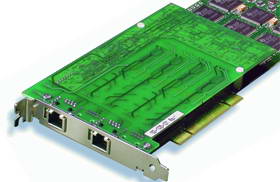
HARDWARE SYSTEM REQUIREMENTS
Pentium 4 or equivalent · 2 GHz or better
PCI motherboard or passive backplane with 3.3V power supply,
PCI2.2/PCI3.0/PCI-X/PCI-E bus
|
Telephony Interface
Trunk Type T1/E1
Trunk Interface Digital network interface
Connectors RJ-45 connectors |
|
Operating Systems
Windows2000 Professional/Server, WindowsXP Professional (SP3),
Windows2003 server (32-bit/64-bit), Windows2008 server
(32-bit/64-bit), Widnows7 (32-bit/64-bit), Windows8 server (Call for variant details)
Technical Specifications
Max boards per system: Any combination up
to 512 ports
Max ports per system: Up to 512
Control Microprocessor: Motorola Coldfire™
RISC
(50 MHz)
DSP: Multiple Texas
Instruments: TMS320C5409 A
Boards errors: On-board LEDs
Clocking: Master/Slave
DRAM: 16 MB per board
SRAM: 128 Kword/DSP
|
T1 Interface
Receive Clock Rate: 1.544 MHz +/-200ppm
Transmit Clock Recovered: RX clock or 50 ppm
Input Level: LBO 0dB to -22dB
Framing: SF (D4), ESF
Line Coding: AMI, B8ZS
Signaling Protocol: ISDN, NFAS, CAS
Robbed Bit Signaling: E&M Immediate, E&M wink,
FXS, FXO
Clock and Data Recovery: Complies with AT&T TR62411
and Bellcore TA-TSY-000170
Loss of Signal Detection: ANSI T1.231
Alarm Detection and Integration: LOS, LOF, Yellow, and
AIS per
ANSI T1.231
Binary Sequence Detector: Per ITU-T 0.151 |
Environmental Conditions
Operating Temperature: 0C to +50C
Storage Temperature: -20C to +85C
Humidity: 8% to 80% non-condensing
Storage humidity: 8% to 80% non-condensing
Physical Characteristics
Form Factor: Full-size PCI card |
E1 Interface
Receive Clock: Rate 2.048 +/- 175ppm
Transmit Clock: Recovered RX clock or 50 ppm
Input Level: 3.2V down to 0.45 V
Framing: Basic G.704, CRC-4
Line Coding: AMI, HDB3
Signaling Protocol: ISDN, DASS2, CAS
Loss of Signal Detection: per ITU-T G.775
Alarm Detection and Integration: LOS, LOSMF, TS16,
CRC,
and Yellow
Binary Sequence Detector: Per ITU-T 0.151 |
Host Interface
Bus Compatibility: PCISIG 2.2/PCI-X/
PCI-E1.1/x1,x4, x8, x16
and Gen 2.0 PCI Express
slots
Bus Speed: 33 MHz
Bus Mode: 32 bit bus master/target
Shared Memory: 16 MB Global shared
SDK
Ai-Logix Native SmartWORKS™ API
SmartControl (Control Panel)
SmartVIEW (card functionality test application)
SmartWF (firmware flash update utility)
|
Audio Signal
Receive range: -68 dBm to + 3 dBm
Input gain control: +24 to -50 dB
Silence Detection: Programmable from API
Transmit Volume Control: +24 to -50 dB
Automatic Gain Control: (AGC)Programmable
from API
Automatic Volume Control: (AVC) Programmable
from API
Activity Detection: Programmable from API
Alert Tone: Programmable
Frequency Response: 300 - 3400 Hz (+/- 3dB)
Trigger Conditions
Event Driven Caller ID,
Min/Max silence ·
Min/Max activity
|
Audio Digitizing (Encoding & Decoding)
5.3 Kb/s: G.723.1
6.3 Kb/s: G.723.1
8 Kb/s: G.729A
13 Kb/s: GSM 6.10, Microsoft GSM
16 Kb/s: G.726
24 Kb/s: G.726, OKI
32 Kb/s: G.726, OKI
40 Kb/s: G.726
64 Kb/s: µ-law or A-law per G.711,
8 bit linear PCM (signed &
unsigned)
96 Kb/s: 6 Khz 16 bit linear PCM(signed)
128 Kb/s: 16 bit linear PCM (signed & unsigned)
Wave file formats: Microsoft GSM, Linear
signed 8 & 16-bit PCM
Digitization selection: Programmable per
channel, independent for
encode and decode
|
Call Progress Monitoring
Number of programmable tones: 20
Number of bandpass filters: 10
Number of filters per tone: 1,2 or 3
Number of cycles: 0 to 255
SIT tones: Yes, programmable frequencies and
duration Answering Machine Detection Yes
Global Tone Generation
Tone Type: Single or dual
frequency
Frequency: range 300 Hz – 3400 Hz
Frequency resolution: 1 Hz
Duration: 1 ms – 8191 ms
programmable in
1 ms steps
Amplitude: +3 dBm to –68 dBm
Duration: API Programmable
Tone Dialing
DTMF digits:0 -9, *, #, A, B, C, D
Frequency: variation Less then 1 Hz Rate API Programmable
|
DTMF/MF Tone Detection
DTMF digits: 0 - 9, *, #, A, B, C, D
MF R2 Digits: 15 Digits Forward & Reverse
per Q.441
Dynamic range: -38 dBm to 0 dBm Minimum tone detection: 40 ms
programmable
Interdigit timing: 40 ms min.
Acceptable twist: Per LSSGR sec. 6, 8 dB
forward, 4 dB reverse
Frequency variation: Accept all +/- 1.5%,
reject all +/-2.5%
Noise tolerance: Per LSSGR sec. 6
Talk off: Bellcore TR-TSY 000762
|
Voice Processing
Echo cancellation: G.165
Caller ID: V.23 & Bell 202
DTMF Detector: Primary & Secondary channel
MF Detection: R1 & R2
Safety and Certifications
Telecom: DOC
Emissions: FCC Part 15 class A · EN 55022
Immunity: EN 55024
Safety: EN 60950
Estimated MTBF: 150,000 hours per Bellcore Method I |
POWER REQUIREMENTS
+PCI 2.2:
+3.3 VDC: 2.8 A
5 VDC: 5mA
-12 VDC: Not Required
+12 VDC: 20 mA
PCI express:
+3.3 VDC: 3.2 A
|
|
Models Available
DT6409/DT6409-eh Dual E1/T1
* -eh denotes PCI-E slot card
|
|
Part number |
|
| 910-0323-001 |
DT6409 |
| 910-0704-002 |
DT6409-eh |
| 910-0702-002 |
PCM6409-eh |
|
|
|
| |